
Revenue generation
Indoor farming will create revenue streams by selling surplus produce to the local community. This revenue can be used to offset living costs, including mortgage payments and utility bills.
LCCH's Vertical Farm
At the heart of LCCH's food security strategy is a state-of-the-art vertical farm designed in collaboration with Planetary Harvest — intentionally labour-intensive, hard to break, easy to fix, and built to produce fresh, healthy produce year-round for every resident.
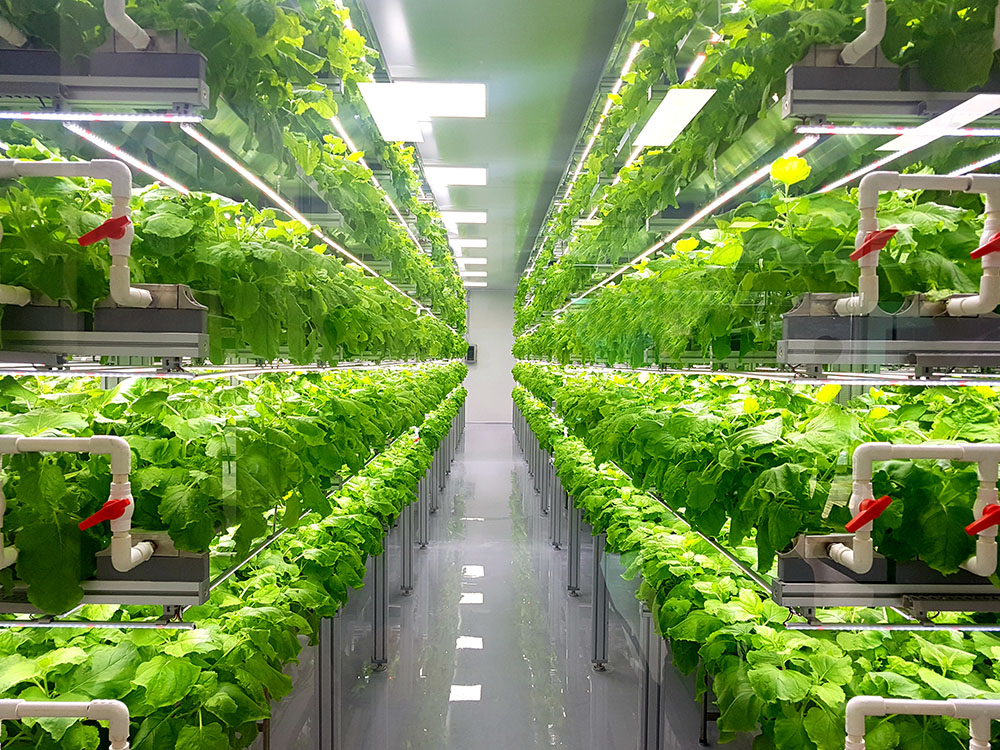
Example visualization of a vertical farm
Vertical farming vision
Vertical farming grows food in vertically stacked layers within a controlled environment. At LCCH, we embrace a low-tech, labour-intensive approach — more like hands-on gardening than an automated industrial system.
By making food production a shared responsibility, residents actively participate in planting, cultivating, and harvesting — contributing to local economic activity, strengthening food security, and advancing food sovereignty. This approach not only produces fresh, healthy food year-round, but also fosters deeper connections between residents, with nature, and with the wider community.
The combination of at-cost co-operative housing and a community-driven vertical farm means residents enjoy tangible benefits: reduced grocery bills, healthier meals, and the pride of knowing their efforts directly nourish their households. It is a model that supports environmental sustainability, economic resilience, and social connection — all in one place.
Food production also demands strict adherence to Canadian and provincial regulations. Regulatory compliance will be essential given that LCCH's project combines an affordable housing component with an integrated vertical farming system. Planetary Harvest will lead the development of a comprehensive Controlled Environment Agriculture (CEA) strategy, covering design, implementation, and risk mitigation planning.
The REVI system
Planetary Harvest has designed a low-tech, labour-intensive vertical farming system adaptable for both fully indoor facilities and rooftop greenhouses. No special tools or advanced skills are required.
Indoor farming will create revenue streams by selling surplus produce to the local community. This revenue can be used to offset living costs, including mortgage payments and utility bills.
The indoor farm creates opportunities for part-time employment, empowering co-operative members with jobs and contributing to local economic development.
The REVI system will ensure a consistent supply of fresh, nutritious food — promoting healthier lifestyles for co-operative members year-round.
The system provides educational resources on sustainable living, gardening, and nutrition — fostering a culture of learning and self-sufficiency within the community.
The indoor farm becomes a focal point for community activities and gatherings, strengthening social bonds while delivering both tangible and intangible benefits to residents.
Light and watering
The prototype system visited in Calgary embodies exactly what LCCH asked for: low-tech, hard to break, easy to learn, inexpensive to repair, and intentionally labour-intensive.
The most advanced element is the LED lighting. These energy-efficient strips are engineered to provide the precise wavelengths plants need for optimal growth. Each planting trough is V-shaped, reflecting light evenly and encouraging natural convection air currents. These currents gently sway the plants, mimicking the movement caused by wind — an important factor in healthy growth — while also reducing the need for powered fans.
Air circulation is handled by a simple, off-the-shelf HVAC fan, which pushes cooler air in at the bottom and pulls warmer air out at the top. Combined with the natural heat from the lights, this design works with, rather than against, natural convection. It also creates micro-climates within each stack: temperate crops can thrive at the cooler base, while tropical varieties can grow in the warmer upper levels. Condensation from the fan can be collected and recycled into the irrigation system.
The watering system uses ancient principles of siphons and rope osmosis. Water from a rain-collected reservoir drips at a controlled rate into a container for each planting bed. Once the container reaches its pre-set volume, the water is siphoned into the planting troughs via shoestring-like wicks. Osmosis draws water evenly into the biochar growing medium. This design functions as a water clock — regulating both the timing and quantity of irrigation without electronics, power, or complex moving parts.
Each planting bed is ergonomically designed for easy access, with pull-out "drawer" troughs about half an arm's length deep. Each trough accommodates three furrows — one central furrow for deeper-rooted plants and two edge furrows for shallower crops. Planting is a simple two-step process: create a shallow trench with a hand trowel, drop in the seeds, and cover.
Growing projections
The LCCH vertical farm is designed with 163,800 vegetable positions, each capable of producing multiple harvests per year depending on crop type.
Revenue is modelled at $3.50 per unit based on observed retail prices of $3–$5 for leafy greens and root vegetables. Given the crop diversity and potential for efficiency improvements, actual output is expected to significantly exceed the conservative projections.
Integrated systems
Because the vertical farm is integrated directly within the LCCH building, it can share resources — air, heat, water, and waste — with the residential areas in a closed-loop system.
Spent air from LCCH residences will be routed to the indoor farm, where plants capture CO₂ before releasing oxygen-enriched air back into the building. This HVAC integration can significantly reduce energy consumption and carbon emissions while enhancing overall air quality.
The waste heat generated by the farm's lighting and HVAC systems can be shared with residential areas, functioning much like a district heating system — enhancing sustainability while reducing energy costs for the co-op and its members.
Water demand will be reduced through recycling of HVAC condensate and irrigation water. Rainwater will also be collected to irrigate residential planter boxes and supplement the farm's needs — conserving potable water and reducing stormwater surges.
All non-edible or unharvested plant material will be composted using a thermal digester system. The resulting compost is re-used within the farm and in residential planter boxes, creating a closed-loop system that reduces waste and enriches growing media.
Because the farm is inside the building, fresh food moves from farm to home in minutes — virtually eliminating the greenhouse gas emissions associated with transporting food into Kingston from elsewhere.
The farm is designed to maximize material re-use and recycling at every stage of production. LCCH will work toward TRUE Certification, recognizing facilities that divert at least 90% of their waste from landfills, incineration, and the environment.
Regulatory compliance
Food production demands strict adherence to Canadian and provincial regulations. LCCH's farm will be designed to meet all applicable standards from day one.